
The Ultimate Mini-Z Tyre Compound Guide
Navigating the world of shore ratings, compounds, and brands to find the perfect grip for your Mini-Z.

In Mini-Z racing, your tyres are the single most important performance upgrade you can make. You can have the fastest brushless motor and the most expensive carbon fibre chassis, but if your tyres aren’t suited to the track surface, you will spend your time spinning out or fighting to keep the car on the line.
Navigating the world of Mini-Z tyres can be daunting. Between “Shore” ratings, various brand-specific compounds, and the technical process of “truing,” there is a lot to learn. In this guide, we will break down the major brands, explain how to read compound charts, and provide a clear path to finding the right grip for your car.
Understanding the “Shore” Rating
The most common way to measure tyre hardness in the RC world is the Shore rating. Measured with a durometer, this number tells you how soft or hard the rubber compound is.
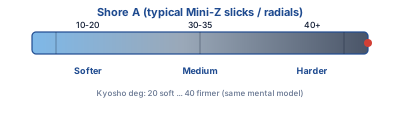
- Low Shore (10–20): These are very soft tyres. They provide immense grip but wear out quickly. They are often used as rear tyres on low-traction surfaces like concrete or cold carpet.
- Medium Shore (30–35): The “sweet spot” for many racers. These offer a balanced mix of grip and longevity.
- High Shore (40+): These are hard tyres. They are often used as front tyres to prevent “traction rolling” on high-grip tracks, or as rear tyres on extremely high-traction surfaces.
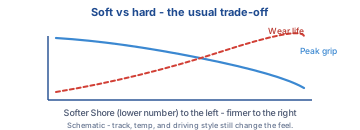
It is important to note that brands like Kyosho use a “degree” system (e.g., 20°, 30°), which effectively mirrors the Shore rating. A 20° Kyosho tyre is soft, while a 40° tyre is medium-hard.
PN Racing: The Competition Standard
PN Racing is widely considered the gold standard for competition Mini-Z tyres. Their compounds are engineered specifically for racing and are categorized into three main families:
1. KS Compound
The KS compound is PN Racing’s most popular race-proven rubber. It is designed to offer increasing amounts of grip as the tyre heats up during a race. It is known for its exceptional lifespan and consistency over long runs.
- Best for: Competitive racing on RCP and high-quality EVA foam.
2. KS-M Compound
The KS-M compound is designed for “instant” grip. It reaches its optimal operating temperature almost immediately, making it the perfect choice for short qualifying sessions or for racing in colder climates (like a chilly Tasmanian winter evening).
- Best for: Cold tracks, short races, and drivers who want maximum bite from the first corner.
3. KSK Compound
The KSK compound is an intermediate option, often positioned between the KS and KS-M. It provides a slightly different “feel” and is favored by some drivers for its specific wear characteristics on older, more abrasive RCP tracks.
Kyosho, Atomic, and Reflex: Other Key Players
While PN Racing dominates the conversation, other brands offer unique advantages:
- Kyosho Stock vs. Upgrades: The stock slick tyres that come on a Kyosho Readyset are notoriously hard (around 40 Shore) and offer very little grip on non-RCP surfaces. They should be replaced immediately. However, Kyosho’s aftermarket High Grip Radials (available in 20°, 30°, and 40°) are excellent and highly versatile, performing well on both carpet and foam.
- Reflex Racing: Reflex is famous for its unique tread designs. Rather than molding a pattern onto the tyre, Reflex often cuts patterns directly into slick rubber. This reduces “tread flex,” providing a more stable and predictable feel under high cornering loads.
- Atomic: Along with PN, Atomic produces some of the highest-quality tuning parts in the world. Their 20-shore “Competition” front tyres are a favorite for racers looking for maximum turn-in on low-to-medium grip tracks.
Comparison: Compound vs. Surface
The table below is a starting point — session temperature and how the car feels on your layout should always override a chart from the web.
| Surface | Recommended Front Tyre | Recommended Rear Tyre |
|---|---|---|
| RCP (New/Clean) | 40 Shore Slick (Hard) | 20 Shore Slick (Super Soft) |
| RCP (High Grip/Grooved) | 42 Shore Slick (Firm) | 30 Shore Slick (Medium) |
| Low-Pile Carpet | 30 Shore Radial (Medium) | 10–20 Shore Radial (Soft) |
| EVA Foam (DIY) | 30 Shore Radial (Medium) | 20 Shore Radial (Soft) |
| Polished Concrete | 20 Shore Radial (Soft) | 10 Shore Radial (Super Soft) |
Note: For AWD Drifting, you should use hard plastic drift tyres on all four corners, regardless of surface.
The Art of Truing
“Truing” is the process of sanding your tyres to ensure they are perfectly round and flat. Even the best out-of-the-box tyres have minor imperfections or molding seams that can cause wobble or inconsistent grip.
Why True Your Tyres?
- Consistency: A perfectly flat contact patch ensures the tyre grips the track evenly.
- Lower CG: By shaving down the tyre diameter, you lower the car’s centre of gravity, which helps prevent traction rolling.
- Rounding the Shoulder: By slightly rounding the outer edge (the “shoulder”) of the tyre, you prevent it from “digging in” during hard cornering, making the car much smoother and less prone to tipping.
How to True
- Mechanical Truers: Advanced racers use a dedicated tyre truing machine (like those from PN or Hudy). These machines hold the wheel and shave the rubber with a rotating sanding drum for mathematical precision.
- The “Sandpaper Trick”: If you don’t have a machine, you can gently hold a sanding block against the spinning tyres while the car is supported. Move from 400-grit to 1000-grit paper in 5-second intervals. Be careful not to overheat the rubber or strain your motor.
Tyre Additives (Sauce)
In larger RC scales, “tyre sauce” is used to chemically soften the rubber and increase grip. In Mini-Z, this is a controversial topic.
On RCP tracks, sauce is generally discouraged as it can damage the foam over time and create “greasy” spots on the layout. On carpet tracks, additives are rarely needed as the rubber-to-fiber interface provides plenty of mechanical grip.
If you are racing on polished concrete, a very small amount of a cleaning agent (like simple isopropyl alcohol) can be used to clean the tyres and restore their natural tackiness. However, always check with your local club rules before applying any chemicals to your tyres.
Our Local Recommendation
For racers in the Tasmanian scene, we recommend starting with a versatile “all-rounder” setup.
If you are racing at a venue like Launceston R/C on their carpet/turf layout, the local favorite is often a high-quality carpet-specific radial. Specifically, the Schumacher Blue Mini Pin has a proven track record for consistent grip and even wear on Tasmanian turf.
For those practicing at home on EVA foam or carpet, a set of Kyosho 30° Radials on the front and Kyosho 20° Radials on the rear is a fantastic baseline. This setup is forgiving, easy to drive, and works across a wide range of temperatures.
Tyres are a deep subject, and your preferences will evolve as your driving skills improve. The best advice we can give is to keep a small notebook of what you’ve tried and how the car felt. In the world of Mini-Z, the “perfect tyre” is often the one that gives you the most confidence to push the car to its limit.