
Tracks and Surfaces: Understanding Where You Race
A deep dive into the four main surfaces for Mini-Z racing—RCP, carpet, concrete, and foam—and how each affects your car's setup.

In the world of 1/28 scale racing, the surface beneath your tyres is arguably the most important factor in how your car handles. Unlike larger scales where you might be racing on dirt, clay, or asphalt, Mini-Z racing is almost exclusively an indoor sport. However, “indoor” can mean many things: from the high-grip precision of specialized foam mats to the forgiving slip of commercial carpet, or even the “ice skating” experience of a polished garage floor.

Understanding these surfaces is the first step toward mastering car setup. Every adjustment you make—from spring rates to tyre compounds—is a response to the interface between the rubber and the track. In this guide, we will break down the four primary surfaces you will encounter in the Mini-Z community: RCP Tracks, EVA Foam, low-pile carpet, and hard floors like polished concrete. We will also touch on the specialized “Astro” and “ETS Tile” surfaces that occasionally make an appearance in more advanced or niche racing circuits.
1. RCP Tracks: The Global Standard
If you look at videos of professional Mini-Z racing from the World Cup or major national events, you are almost certainly looking at an RCP Track. RCP (which stands for the name of the manufacturer) is a specialized, rubber-infused EVA foam mat. It is modular, typically coming in 50cm or 30cm squares that interlock to create complex layouts.
Grip Characteristics: RCP is known for having very high traction. Because it is infused with rubber, it has a “living” quality; as more cars drive on the track, they “lay down rubber” into the surface, which causes the grip level to increase over the course of a race day. It is also highly sensitive to environmental factors like temperature and humidity.
Driving Feel: Racing on RCP is an exercise in precision. Because the grip is so high, the car responds instantly to every input. However, this high traction comes with a catch: “traction rolling.” This occurs when the outside tyres bite so hard into a corner that the car’s momentum flips it over. To race successfully on RCP, you must tune your suspension to manage this weight transfer and choose tyre compounds that provide enough bite without being too aggressive.
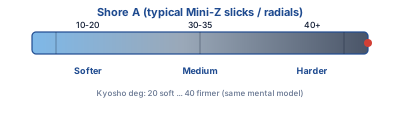
Tyre Choice: Most racers on RCP use a combination of slick or radial tyres. A common baseline is a medium or firm front tyre to prevent the car from being too “twitchy” on turn-in, paired with a super-soft rear tyre (such as a 20-shore compound) for maximum acceleration out of the corners.
2. DIY EVA Foam: The Home Hero
For many hobbyists starting out at home, official RCP can be expensive and difficult to source. The popular alternative is standard interlocking EVA foam mats, often found at hardware stores like Bunnings or Harbor Freight.
Grip Characteristics: Standard EVA foam offers high grip, but it differs from RCP in one key way: it lacks the rubber infusion. Most DIY mats also come with a factory coating that can feel slightly “waxy” at first. Most racers choose to drive on the smooth side of the mat, as the textured “diamond” side is generally too inconsistent for grip racing (though it can be excellent for drifting).
Driving Feel: Driving on high-quality DIY foam feels about 90% similar to an official RCP track. It is an excellent practice surface, but because the grip is slightly lower than RCP, a car tuned perfectly for your home track might feel slightly “under-steered” when you take it to a club meet.
Tyre Choice: Soft radial tyres (20 or 30 shore) are the gold standard here. They provide enough “hook-up” to allow for consistent lap times without the extreme risk of traction rolling found on prepped RCP.
3. Low-Pile Carpet: Forgiving and Fast
Carpet racing has a long history in RC, and Mini-Z is no exception. In Tasmania, many multi-purpose venues use low-pile commercial carpet or “marine” carpet for their tracks.
Grip Characteristics: Carpet generally offers less maximum grip than foam, but it is incredibly consistent. Like RCP, carpet develops a “groove” over time as fine rubber particles from the tyres get worked into the fibers. However, this groove is fragile; vacuuming the carpet will often “reset” the grip level to its baseline.
Driving Feel: Carpet is much more forgiving than foam. The slightly lower grip means traction rolling is much less common, allowing you to drive the car harder into corners. It is also much gentler on your tyres; a set of radials that might wear out in a few hours on RCP could last for weeks on a carpet track.
Tyre Choice: Kyosho radial tyres are the preferred choice for carpet. Interestingly, the stock slick tyres that come with Kyosho Auto Scale bodies are almost unusable on carpet; they simply cannot find purchase on the fibers, leading to constant spinning.
4. Polished Concrete and Hardwood: The Challenge
Most people’s first experience with a Mini-Z happens on their kitchen or garage floor. While convenient, these are the most difficult surfaces for grip racing.
Grip Characteristics: Polished concrete and hardwood offer extremely low grip. The biggest enemy here is dust; even a microscopic layer of dust on the floor will get picked up by the rubber tyres, turning them into “plastic” wheels with zero traction.
Driving Feel: On these surfaces, grip racing feels like “ice skating.” The car will want to spin out under even moderate throttle. However, these are the ideal surfaces for drifting. If you have an AWD (All-Wheel Drive) Mini-Z equipped with hard plastic drift tyres, a polished concrete floor becomes a playground.
Tyre Choice: For grip racing on concrete, you must use the softest radials available (10 or 20 shore) and keep the floor “surgically clean.” For drifting, any hard plastic drift tyre will suffice.
5. Astro and ETS Tile: The Specialists
While rarer in the 1/28 world, you may hear mention of “Astro” (Artificial Turf) or “ETS Tile” (the specialized carpet tiles used in the European Touring Series).
Astro/Artificial Turf: In Tasmania, Astro is a staple of 1/10 scale off-road racing (such as at Launceston R/C). For Mini-Z, it is occasionally used for “Micro Off-Road” tracks. It provides immense grip but can be very bumpy for the small 1/28 suspension. Racing on Astro requires “Mini Pin” tyres—tiny spiked tyres that can dig into the turf.
ETS Tile: These are high-density, low-pile carpet tiles designed for maximum consistency. They offer a grip level somewhere between standard carpet and RCP. They are the “luxury” option for carpet racing, providing a perfectly flat surface that is easier to maintain than a single large roll of carpet.
Summary: Matching Surface to Style
Your choice of surface ultimately dictates your racing style. If you want the ultimate in professional, high-grip competition, RCP is the destination. If you want a forgiving, budget-friendly way to race with friends, carpet is hard to beat. And if you just want to slide your car sideways in the garage, polished concrete is your best friend.
In our upcoming posts, we will look at how to tune your car’s “Front End” and “Rear End” to match these surfaces. But for now, take a look at where you’re racing—it’s the most important setup choice you’ll ever make.